Originally published for the Intelligencer at NYMag.
When New York–based activists Rise and Resist planned to use Independence Day to protest the Trump administration’s immigration policies, their objective was simple: to unfurl a banner declaring “Abolish ICE” on Liberty Island. Patricia Okoumou, however, took it further, risking life, limb, and liberty in free-climbing the 100-foot-tall pedestal base of the Statue of Liberty and lying at its feet. During the three-hour standoff, she repurposed her shirt into a flag of its own, defiantly displaying the call to action to “Rise and Resist.”
When I was a child, my mom would tell me stories about Ramadan in our homeland of Comoros. Some parts weren’t the most idyllic—the idea of fasting under mosquito nets without air conditioning that close to the equator is not my concept of pleasant by any stretch of the imagination.
The one part that I always envied, however, was the sense of community enshrouded in each story. The collective participation in the holy month made the air crackle just a little differently, and you could feel the nuance in every vignette. Continue reading →
Every spring, Black students at predominantly white universities (PWIs) across the United States participate in Black Commencement, an event dedicated to celebrating the shared experience of successfully navigating their respective institutions. Often the ceremony is highlighted by a “donning of the kente,” where the soon-to-be graduates are presented with ceremonial stoles, often ornamented with lettering of their choice, be it Greek-organization or social club, to proudly decorate themselves with during the experience they will share at the university-wide commencement.
“Donning of the Kente” Ceremony
More often than not, the kente on the stoles is not authentic; kente being a rather dense and heavy fabric laboriously hand-woven by the Akan peoples of Ghana. Instead, the stoles feature mass-produced kente-like prints, and while an African-named vendor may sell the kente stoles, a cursory look at the lining will confirm that it is in fact “Made in China.”
Weaving of kente cloth
Nevertheless, this phenomenon is not unique to the celebratory kente stole. In the post-colonial era, consumption of “African” wares and content has frequently mutated into an investment into an aesthetic rather than a verified artifact indigenous to a community or culture, a predicament that has cascaded overtime on both sides of the Atlantic Ocean. Africana-as-commodity is much easier to market and distill than the unique labors of localized people – an unfortunate byproduct of the acquisitive industrialized capitalist era where profits trump legacy. The impacts of the marketization of identity are most apparent by the significant exports that arose; and what is highlighted when we discuss “African identity” and the attempts to signal our affiliation with Africana can be tracked by the expansion of the intercontinental fabric market (and subsequent transformation of attire) over the course of the 20th Century. The most profitable trades – in this case, textiles – have a direct impact on shaping the narrative of one of the most revisited questions across the Black Diaspora: “how can I connect better to Africa?”
In general, when people speak of wanting authentic “African prints” they’re frequently referring to Ankara, which is in actuality a Dutch invention – a repurposing of the Indonesian “batik” method that was originally intended for the Javan markets but more readily adopted by elite West Africans. To this day, the oldest and largest company producing Ankara fabric, Vlisco, is headquartered in the Netherlands, despite purporting itself as the “originator of African wax” with flagship stores in the elite urban enclaves of Accra, Lagos, and Johannesburg. As highlighted by Tunde Akinwumi in his research paper The African Print Hoax, “what is obtainable in the contemporary time as African print is nothing but a wholesale copy of Indonesian batik style.”
No matter the deceptive origin, however, the marginally tweaked fabrics and patterns provided a level of homogeneity to an entire region within the vast continent of Africa, that is in fact home to dozens of ethnicities, languages, and lived experiences. African prints provide a more natural market sell then the adire of Nigeria or Ashanti adinkra. The business has expanded rapidly – the industry went from purely selling textiles by the yard to repurposing into remade fashion wares, such as hats, bathing suits, and purses – and Vlisco quickly began to face competition not only from textile companies in Ghana, Nigeria, and Senegal, but also “counterfeit” materials coming in from Chinese traders, which undercut the market due to the significantly lower manufacturing price point. There is an inescapable irony to there being an imitation market for a fabric industry constructed out of a manufactured reality – the term “African wax” itself is just as fraudulent as the Asian production factories that emerged to meet the increased product demand. This accelerated industry growth, however, created a window for expansion, leading to the increased export of the textiles to the United States – in tandem with increased immigration from West Africa to the United States.
The Immigration and Nationality Act of 1965 eliminated national immigration quotas, which allowed for an influx of West Africans searching for a new labor market in urban hubs such as Harlem, New York City, the peak of which took place in the 80s and 90s. This migration, however, came with a flattening of a demographic; communities weren’t Fulani, or Hausa, or Wolof, or Soninke – they were merely African, and ultimately established trading networks that were cross-tribal and cross-national from the regions they considered their original homelands. Senegalese vendors would make connections with Ivorian manufacturers and vice versa – a circumstance ameliorated by the fact that these textile markets were all producing the same amorphous Ankara, authenticated by the presence of an African face, but not inherently native to one location. As the Chinese and Taiwanese production markets undercut the more onerous costs and tariffs of imports of African textile companies, immigrant vendors traded in those relationships as well, buying into the idea of profiting off of Africana-as-commodity vs. standing by Africana-as-identity: the performance of a uniform, homogeneous African identity generated capital in ways that stratifying the distinctions would not. Today, one can enter the storied “Malcolm Shabazz Harlem Market” in what was formerly known as the “Little Senegal” enclave of Central Harlem (although not nearly as Senegalese anymore, courtesy of aggressive gentrification), and find a vendor proudly selling “authentic African clothes and fabrics” despite the textile facility being based in China, enjoying the higher margins at $7 a yard as opposed to a price nearly double that which would be required of West African textile operations.
Malcolm Shabazz Harlem Market
This rapid commodification arose in tandem with the rise of Afro-centric hip-hop in Black American culture. The late 80s and early 90s saw the explosion of the “Native Tongues” era – De La Soul, Tribe Called Quest, Jungle Brothers, Queen Latifah – who all sought to represent Africana not purely in their lyrics but in their presentation. The dashiki – a West African Hausa export – made its reappearance in music videos and films such as Poetic Justice as a continued symbol of Panafricanism and black liberation, and with these trends came the heavy investment in the loud Ankara prints in the West. Regardless of the faux affiliation with African tribal legacy, the fashion served as an external symbol of kinship with the greater diaspora – a commodity that superseded any expectations of authenticity, the impacts of which continued to reverberate as hip-hop expanded into a global enterprise and capitalist machine. Dashiki production quickly escalated – not as an outgrowth of Hausa or Islamic Africana identity, but as a trend affiliated with the worldwide phenomenon of hip-hop, and the Asian markets rapidly integrated these styles into the ever-expanding repertoire of “Africana” textiles and fashions. Now, continent-wide, you can see people donning dashikis, not as a representation of cultural affinity, but as a tangible association to hip-hop culture.
A Tribe Called Quest
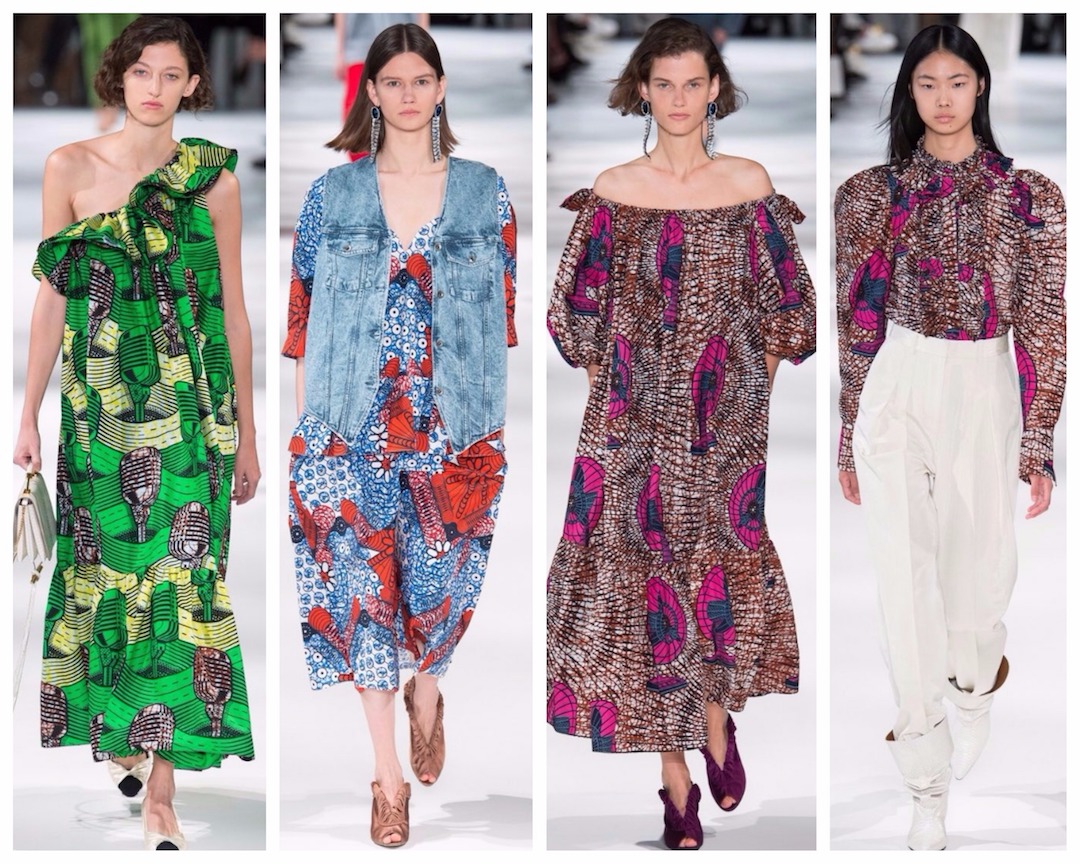
Over the last two decades, the expansion of the Ankara aesthetic in West Africa and into the West has turned into a boomerang effect into the rest of the continent – bold Ankara print outfits can be found from South Africa to Mozambique to Tunisia, highlighted in fashion blogs and magazines as “the best of African style,” despite the absence of African origination. The African owned textile factories themselves have severely decreased production by figures reported by The Financial Times of as much as 75 percent in Nigeria, due to the inability to maintain scalability and profitability in competition with Asian manufacturers. Yet the consumption of the fabric is steadily increasing – as the years proceed, new African or “African-inspired” designers have continued to utilize the Ankara, kente, and dashiki as distinct components of marketable fashion, regardless of the authenticity or origin of the style of production: just this past weekend, Black Panther premiered to the general Western public and thousands, if not millions of Black people throughout the diaspora proudly displayed their “royal attire” to celebrate the advent of the fictional nation of Wakanda to the big screen. There’s also the “kentekini,” which made waves as a modern twist on “African fashion” in 2017. In 2013, Michelle Obama infamously donned two separate Ankara dresses, which quickly circulated throughout the West African blogosphere; and most controversially, Stella McCartney previewed her “African inspired” Spring 2018 line, laden with white models parading Ankara prints, to significant pushback from the African diaspora for erasure.
Stella McCartney RTW Spring 2018
The Stella McCartney fiasco brought to a head the longstanding problem: can we now say that Ankara is officially “African” despite it not being our own creation? Is the fact that the Ankara print is commonly associated with “authentic African fashion” enough to claim any other use of it as appropriation? It would seem that for now, Africana-as-commodity has successfully superseded any required discussions of authenticity or identity. We are defending our public face, our homogenous market, a kinship created out of capitalism and white supremacy, while the localities suffer; because whether it is sported by a self-professed Afropolitan, Pan-African, or Anglo-Saxon, the textile profits are almost certainly coming from Asia and not West Africa.
Ankara and “kente” and “dashiki” in all of its iterations and mutations have been shared throughout social media to a litany of view, likes, and retweets. I cannot pretend that it isn’t a joy to see Black people showcasing our affinity for colors and patterns, in all of our vibrancy and vitality. However, the Africana-as-commodity vs. Africana-as-identity debate remains: is it more important to signal kinship to the African identity, regardless of true origin, manufacturing, and branding as opposed to genuinely drawing out authentic African production? Should we feel uncomfortable donning kente that is not being created in the authentic Akan weaving style while wistfully fantasizing about an African land that is free from the impact of colonialism, imperialism, and slavery? I don’t deem to have the answer, but I can only hope that we continue to use this global cultural touchpoint to further the discourse about the ethics of such a critical intersection of identity and capitalism, and strive to understand what we are really seeking when we associate these Chinese productions as our connection to the Motherland.
Sometime Thursday, Donald J. Trump waddled into the Oval Office at 1600 Pennsylvania Ave. in Washington, D.C., and not only blustered that immigrants from the countries of Haiti, El Salvador and the entire continent of Africa are “people from shithole countries” but also encouraged more immigration from countries such as Norway and the continent of Asia because of some perceived economic benefit to the U.S.
Originally published on the Washington Post’s Global Opinions section.
French President Emmanuel Macron has hit the ground running on his promise of an inclusive government, naming a cabinet of ministers across the political spectrum and backgrounds. Half of his cabinet is also made up of women — including the premier cabinet position of defense minister; the cabinet also includes a former black female Olympian as minister of sports.
Still, racial inequalities and xenophobia are pervasive in France. Macron was soundly criticized last week for making a joke that mocked the plight of citizens from the small African nation of the Comoros for taking the kwassa kwassa, a small fishing boat, to try to get to the neighboring island of Mayotte — a French principality that was a part of Comoros but repossessed by France after independence. The Comorian government has made public statements demanding an apology, and there have been large protests from the significant Comorian population in France, especially in Marseille and Paris.
Macron has used progressive rhetoric, stating that he is in favor of inclusive, open borders and reinvestment in the European Union. But his proposed initiatives leave much to be desired on issues of domestic equality for France’s ethnic minorities. During the run-up to the election, Macron pledged to recruit approximately 10,000 more police officers in response to the increased frequency of terrorist attacks in the past two years. However, this effort comes at a stark cost to disenfranchised, lower-class immigrant populations of France that have had adversarial relationships with law enforcement.
In the past year alone, the French police have come under fire twice from immigrant communities in the maligned banlieues and high-rise towers in the outskirts of Paris for aggravated police violence.
On July 19, 2016, Adama Traore, a 24-year-old son of Malian immigrants, died under suspicious circumstances mere hours after being taken into police custody for not having proper identification. Subsequent calls for justice by the community at-large and his family have largely resulted in recrimination, with two of Adama’s brother’s, Bagui and Youssuf, having been sentenced to several months in prison for threats and violence toward officers after attempting to demand answers at a city council meeting last November.
On the heels of this tragedy, 22-year-old Theo (whose surname has been protected) was allegedly sodomized by French police forces on Feb. 2 after being stopped for simply being in a large group. (French prosecutors later alleged there were suspicions of drug activity in the area.) While he survived, Theo underwent major surgery to repair the tearing from the assault, which was initially reported as an accident of his own doing. The weeks of protesting and organizing that broke out after these two incidents — and a subsequent bevy of arrests — brought a tragic awareness of the disregard for the lives of young men and women of color in France by the police. For them, the prospect of an increased police force doesn’t bring comfort, but rather increased fear and distrust.
According to reports, anywhere from 60 percent to 70 percent of the French prison population is of Muslim and of immigrant African descent, despite the fact that the overwhelming majority of terrorist attacks have been committed by French citizens. There is no indication that this trend will go away under Macron; instead, his move will increase pressures on African immigrants rather than finding structured initiatives that will actually address France’s security issues.
Macron may have positioned himself and his cabinet as progressive knights in shining armor to push France forward — but for minorities and people of color, his proposed initiatives reflect a continued disenfranchisement and dismissal. While progressivism is by no means a zero-sum game, it would behoove the new leader of France to ensure that any initiatives improve the status quo for the country’s minority populations instead of reinforcing it. Doing so would require coming to terms with the reality that racism in France can be just as institutionalized as in the United States.
Originally published on VerySmartBrothas and The Root.
I have an older cousin named Halima. She lives in Nimes with her husband and five-year-old daughter, named Hikma, who is an avid Frozen enthusiast (called La Reines des Neiges in French) and Beyonce-in-training.
For the most part, they live relatively peaceful middle-class existences. But every morning, Halima makes the trek from Nimes to Avignon to go work at the hospital there — and every morning, she quietly recites the basmala to herself. Bismillahirrahmanirrahim – “In the name of God, the Most Gracious, the Most Merciful.” Those few words help her muster up the strength to get on the train and face her sincere fear that her next day on public transportation could be her last.
It should be no surprise that anti-Blackness is a phenomenon that extends to Western Europe, considering that they were the initial settlers of what is now America and the Transatlantic Slave Trade. However, the concept that countries like France are these magical, post-racial havens for the truly evolved and erudite has been a concept that seems to have persisted from the Baldwin era. Visions of smokey rooms where elites hobnob with Black American intellectuals over cognac and transcendent jazz music continue to be the predominant perspective, drawn out from the near-reverent recounting of Black American academics and artistic contemporaries from the Harlem Renaissance and post WWI-era.
You even see it in present day with renowned race and culture commentator Ta-Nehisi Coates, who during a recent interview, said the following:
“..the sociology that comes out of slavery is a little different from the sociology that comes out of colonialism. France colonized all sorts of people—Asian people, black people, whoever. So the relationship is a little different. It’s not a good relationship. But America has a very specific thing with black people. Here, the people who get it the worst are actually the Muslims…”
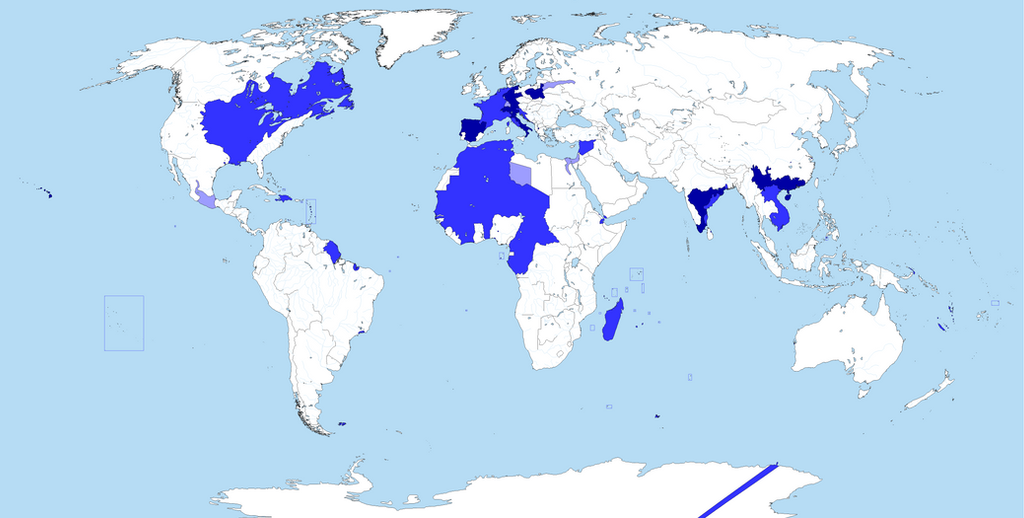
While that may be a seemingly innocuous statement, it obscures a few key things. Most glaringly, there’s an implication that France did not participate in chattel slavery, which it did, as did most Western European empires at the time. Secondly, while it is true that the French colonial empire extended to parts of Southeast Asia, any map of the modern French colonial empire will make it plainly clear that their rule extended primarily over Black nations — and that autonomy over Black states extended well into the the 20th century. The country where my family is from, Comoros, didn’t obtain independence until 1975; which is to say, my mother was born under French rule, with a French passport, and a French birth certificate.
What is arguably most glaring is this attempted bifurcation of race and religion — identities, which in France, are almost inextricably linked. Yes, France has a strong case of Islamophobia, which is made quite evident by things such as the “secular” law banning women from wearing religious headdresses in public, as well as the recently passed law enabling French government to revoke the birthright citizenship of anyone convicted of “terroristic” activity — terroristic activity being this amoebic catchall that is yet to be defined, of course.
That said, the key oversight in that assessment is that of the millions of French citizens and residents that self-identify as Muslim, approximately 80% of them at last count were 1st or 2nd generation descendants of the African continent. Subsequently, it is these people who are consistently harassed; pulled off trains and demanded to show their papers, pushed into slum communities (also known as banlieues), denied jobs they are qualified for, quality education or service without cause, arrested with limited justification, belittled via “satirical” comics.
And yes, even murdered, as we are in the United States.
On July 19th, Adama Traore, a Black Muslim Frenchman, died on his 24th birthday in police custody. As I write this, the family still doesn’t have any concrete answers as to what happened during his transport. This is a tragedy that we are all too familiar with here in the US, but it is a pain that reverberates globally; the extinguishing of Black bodies with little disregard or concern for the communities that continue to sear with the remnants of that anguish.
It is for those reasons that my cousin prays. She prays to get home in one piece. She prays to not run into law enforcement. She prays for her daughter to not have to recall her in memories before she should have to.
This isn’t the part of France you will see on TV. It might not even be the part of France you see in person; the banlieues exist on the outskirts for a reason, and if you just stay in the 20 arrondissements of Paris with your American passport in full view you may just consistently be viewed as a tourist first. I would certainly assume that a writer of Coates’s stature would be of the means to stay close to the city center, nor do I deride him for that choice. That experience, however, doesn’t dismiss the suffering of large swaths of Black communities just a few miles south. Black neighborhoods are being torn apart by fraught relationships with both police and non-POC demographics, and they are crying for their voices to be heard. We should take pains to not erase that context in framing our own personal experiences.
Baldwin once said of America, “all you are ever told in this country about being Black is that it is a terrible, terrible thing to be.” That sober reality unfortunately still hold us tight in our clutches in 2016; not just in the United States, but in large swaths of the Western World. Anti-Blackness is everywhere, even in the home of the Age of Enlightenment; and it would behoove us to step away from viewing White supremacy as a uniquely American problem as much as it is a pervasive viciousness that has left its imprints on Black populations the world over.
Originally posted in Washington Post’s “In Theory” section.
The first time I can remember hearing the word “feminist” in any capacity was in middle school, back when we had to complete presentations on suffragists during Women’s History Month. However, it wasn’t my book report on Susan B. Anthony (or whomever it was) that served as my introduction to feminism.
When I was watching the first episode of Black-ish, I felt a certain level of understanding of Anthony Anderson’s worry of his kids retaining their culture/identity/hood pass, as I’m sure most of us did. For me though, it extends beyond the “black in America” experience. Continue reading →