Did Afropunk Lose Its Punk Roots?

Originally published for VerySmartBrothas in Aug 25, 2017.


This weekend, a sea of unapologetic blackness will descend upon Fort Greene’s Commodore Barry Park for Brooklyn, N.Y.’s 12th Annual Afropunk Fest. Instagram feeds and Twitter hashtags everywhere will be peppered with twist-outs and bold prints; your favorite vibe curator will inevitably make a thread of the best of the best of the audience’s fabulous crochets and Afrocentric jewelry. For 48 hours, Snapchat stories will be dominated by a time capsule of what the festival organizers have described on their home page as “a day of live music and good vibes.”

It’s clear to anyone with a pulse on black digital media that the zeitgeist is currently led by celebrations of “peak melanin,” “unapologetic blackness” and branded T-shirts to match; it stands to reason that Afropunk is an organic extension of this branch of cultural exultation. However, the Afropunk of 2017 is a far cry from the inaugural gathering of 2005—not to mention the namesake 2003 documentary by James Spooner that was the inception of it all. In little over a decade, the event has gone from a donation-only gathering to a $55-per-day festival with notable sponsorship from international brands such as Toyota, Coors Light and Red Bull.   

Transition, of course, is natural. That said, in the wake of this evolution seems to lie the rubble of the original core fan base that Afropunk was conceived to service: a cultural niche that grew out of a film whose original intended title was “The Rock and Roll Nigger Experience.” How does that fan base feel about the current iteration of this space? And what conversations should we be having about the trade-offs between demographic integrity and mainstream appeal?


I won’t pretend to be an in-depth consumer of the punk or alternative rock scenes. In their biggest early-aughts mainstream heyday, I enjoyed the occasional Linkin Park, Jimmy Eat World and Evanescence like any other New York teen that listened to Z100 in addition to Hot 97. The beauty of this city, however, is the ability to form deep connections with people whose varied interests expose you to significant communities you might never have known existed.

In the summer of 2012, a friend introduced me to Afropunk Fest, a donation-only event that two artists I adored, Alice Smith and Erykah Badu, would be performing at. Intrigued, I trekked from my Astoria, Queens, apartment to Brooklyn, where I immediately realized that I was the distinct outsider. I may have been there for a performance of “Tyrone,” but the overwhelming majority were there to see performances from rock groups such as Bad Rabbitsthe Memorials and Cerebral Ballzy, all led by people of color and continuing in the tradition of previous performers such as Unlocking the Truth, Bad Brains and TV on the Radio (the latter two of whom were featured in the original doc). Smack-dab in the middle of the park was a half-pipe for what was boasted to be the largest street skate and BMX competition in New York City. Surrounding me were spiked leather cuffs, lip rings and bicycle chains attached to brown faces for as far as the eye could see.

I also ran into my longtime friend Curtis, who has been active in the punk scene for over a decade, regularly making treks to Long Island for staple punk events such as Warpedor attending Bad Rabbits concerts. In the course of talking with him about the significance of Afropunk, he said, “Being in a space like Afropunk is a relief; it’s a chance to be you, as loudly or quietly as possible, without it ever being weird. A place to be celebrated, or even just acknowledged, without being ogled.”

While I quickly assessed that this safe space wasn’t something I could call my own, I was happy that it existed for a community that contends with the duality of self-celebration in a genre that was disproportionately white, and I continue to appreciate friends like Curtis for providing critical context to that unique lived experience.

In the five years since, the photographical vignettes have drastically changed; the sea of brown faces that reflected a punk aesthetic seems to have been reduced to a Where’s Waldo? game in which the reward is a melancholy reminder of what was once the majority. And while it is by no means the fault of the patrons who currently choose to enjoy the new offerings of the organizers, I can’t help wondering what it feels like to be one of those faces who has watched a space turn from familial to minimizing.


I am far from the first person to note the concern about Afropunk’s evolution into the goliath that it is now. Spooner himself disassociated from the event in 2008. In 2013, Devon Maloney wrote an in-depth piece for the (sadly, now going digital-only) Village Voice,noting that “As with all underground movements that reach a certain level of recognition, amplification for Afropunk has become increasingly difficult, if not impossible, to achieve without concessions, and those concessions are usually the minority voice.”

At the time, organizer Matthew Morgan’s rebuttal was that “if it was so mainstream, we wouldn’t have one festival like Afropunk. We would have as many festivals like Afropunk as we do Lollapalooza, Hard Fest, Coachella, BonnarooThere would be one in every city.Of course, since then, Afropunk has expanded its reach from Brooklyn to corresponding festivals in London, Paris, Atlanta and Johannesburg, with the London iteration receiving heavy criticism for initially booking (and later dropping) problematic fave M.I.A. to headline the festival.

The topic was again revisited in 2015 by Brian Josephs for Vice, detailing how first-wave participants were “skeptical about something personally impactful being corrupted.” Most recently, in a 2016 package for NPR, Morgan addressed the rapid expansion of the space that Afropunk was occupying by declaring that “It’s punk rock to be black in America.” It’s a sentiment that draws easy concurrence from the inherent subversiveness and defiance of simply existing as a black person in this country, but it remains a distinct shift from Spooner’s intent to emphasize a distinct subculture and “minority in a minority” in favor of hypervisibility and the trappings that come with it.

As Curtis aptly pointed out, “Blackness is a counterculture, a counterexistence, by design. Anything that centers and celebrates blackness is subversive, is punk. That said, I’m also reminded to question the extent to which something meant to be subversive can end up being appropriated back into the normative narrative, supporting that narrative instead of undermining it.”


When it comes to conversations of blackness and black culture—however you choose to define that—it’s easy to talk about systemic progress for the whole and gloss over its unique components, while simultaneously uttering the common refrain, “Blackness is not a monolith.” It is this sort of cognitive dissonance that can overshadow conversations on stratification in the black community and on the tug-of-war with the desire for a cohesive branding of black excellence and black unity; you see it tingeing discussions around black gentrification, “hood” appropriation and the oft-revisited “Diaspora wars.” The labeling of the term Afropunk isn’t exempt from this struggle.

In my talks with Curtis, he examines that balance:

There’s the more abstract question of whether this is even a welcoming space for those folks anymore. Punk is in the name, but it’s not that simple; punk rightfully takes on a different meaning when it intersects with blackness. What that means, though, is that it becomes more difficult to stay open and inclusive. Especially when there appear to be dollars at risk.


It would be unfair to assert that the “punk” has been completely eliminated from Afropunk. In the upcoming festivities, the lineup includes returning act Unlocking the Truth, as well as RebelMatic and Pure Disgust, but a cursory Google search will make it evident that the performances being promoted and highlighted, both via publications and physical posters, are the likes of Solange, Anderson Paak, Sampha and SZA—all artists that I certainly enjoy but are more associated with a punk attitude rather than musical influences.

The aforementioned half-pipe seems to have been reduced to a footnote, with reports saying the previous year’s festival had one tucked away from the main festivities. All in all, it’s not hyperbolic to point out that in search of increasing cultural resonance, the Afropunk of today is largely unrecognizable to the one of the early aughts: a bittersweet victory for a community that had once seemingly found a haven in the brainchild of Spooner and Morgan.

The intent is not to finger-wag at current patrons—paying a ticket to see acts you enjoy doesn’t inherently make you the culprit of erasure—as much as to encourage discussion about how we conscientiously engage in the mainstreaming of black culture and how that mainstreaming can subsume the niches that currently exist and will continue to form.

As it stands, it is not always true that the whole is greater than the sum of its parts, especially when the parts may not be seeking more than access to kinship and a shared experience that may not be readily connected to “the culture.” And when that culture seeks to redefine the narratives of a clearly defined genre, it behooves us to examine precisely what may be lost as a consequence and to initiate discourse on how we can best examine, acknowledge and accommodate that loss.

While I may personally grapple with the best way to convey the growing fissure left in Afropunk’s metamorphosis, Curtis incisively identifies the sour notes that bubble on the perimeter of the event in recent years:

What’s different about Afropunk is that it’s a single event, not an entire scene. It doesn’t have the room for local offshoots, niche versions, remixes and reinventions to constantly fill gaps where the general scene fails to. And yet, it seems to have set a high bar for itself over the years when it comes to inclusion and diversity, one that becomes a lot harder to reach when commercial concerns come into play. I still love the idea of Afropunk, but it’s hard to put a lot of faith into it. It is going to take a lot of work for it to continue to be a truly subversive event, and not just another spectacle of blackness, stripped of the nuance and complexities that make us human.

For now, Afropunk-as-genre seems to have been stifled for Afropunk-as-culture, and countering the monolith while also becoming the monolith is a tough tightrope to walk. In the meantime, we should continue to consider the realities of the legacy and tradition that Afropunk was born from, and do our best to include that spirit in future rhetoric and conversations on the identity, subversiveness and counterculture that layer into the various dimensions of black existence.

Body Image and Me: My Struggle With Body Dysmorphia

Originally published for VerySmartBrothas on August 15, 2017.


A few months ago, I reconnected with a dear friend whom I hadn’t seen in quite some time. We met up for brunch, laughed about prior fights, squashed beefs and updated each other on our personal lives in between bites of truffle fries. In between convos about the escapades that happened during our distance, I mentioned that I was trying to lose 15 pounds to get my body back right. Unexpectedly, she told me, “Shamira, the entire time I’ve known you, you’ve been trying to shed 10 to 15 pounds. At every size.”

Seasons later, that line still sticks with me. Not only because she was right—she absolutely was (and is)—but because I know that I say 15 pounds when I often mean 20 or 25 or 30, depending on the day, level of stress in my life and mirror I passed. My volatile relationship with my body has existed since I was at least 9 years old; it’s become so ingrained into my daily psyche that I don’t know myself without it and don’t understand a world in which I’m not over-scrutinizing every dip and crevice to the point of distraction.

I’m not so deluded as to think I’m actually obese; in my moments of rational thought, I grasp that I’m in a healthy range for the average woman in America, and as someone who has danced and played sports my whole life and currently has a regular gym routine to boot, I’m likely fitter than the average American, thigh meats notwithstanding. And there are certainly days when I pass myself in the mirror, tell myself, “Damn, who let that bad bitch in the building?”and flood my various social media networks with a stream of selfies and Snapchat filters.

Nevertheless, in every new relationship, the pattern is the same: I make an offhand reference to my (perceived) growing frame, my partner tells me they love my thick body, and I end up in a seemingly never-ending tailspin of disgust, despair and denial until I somehow make it out of the other end.

Before I make it out, however, I’m weighing myself six times a day—after every bowel movement and every piss. I’m dodging mirrors because I can’t stand to see myself naked. I’m declining invites to go out because despite rational thought, my brain still can’t stand the thought of my fat self being exposed in photos to unflinchingly look at, whether all 5 feet 10 inches of me weigh 135 pounds or 175 pounds.

When I’m terrified to weigh myself because I don’t want my day ruined, I’m knocking on my clavicles for reassurance that they’re still visible and wrapping my left thumb and index finger around my right wrist to check that it’s still small. I’m examining how my rings fit to check for bloating. And the darkest part of me, despite how unhealthy I was and how I was starving myself to maintain during a rigorous dancing circuit, misses me at that “curvy” 135—to the point that I cried to my boyfriend on my birthday after sitting next to a model who was thinner than I could ever be in this universe or the next, ashamed that my most immediate visceral reaction to seeing her frame was envy.

Ibrahim’s “curvy dancer” phase at 138 pounds

Body dysmorphia has an uncanny ability to warp your mind in a way that seeps into your brain like a vice and grasps on without a care, imprinting any bad perception into your head to agonize ad nauseam, regardless of positive reinforcement from your friends and family. I can’t tell you how many times I’ve just nodded and said thank you because I was out of ways to explain to a romantic partner or friend that I just couldn’t see what they did, or that something as small as lovingly grabbing my food baby can make me cry myself to sleep depending on the day.

I wish so bad that I could look through the same mirrors my loved ones saw; I wish that I could stop lying every time I drop 20 pounds out of nowhere that I was training for a half-marathon instead of working out for three hours a day and intentionally eating under 1,000 calories for a month; I even wish that my perceptions of my body were tied to male acceptance of my figure—but men have sexualized me from when I was an 8-year-old with baby fat to when I was an undergrad student so depressed that I was running 11 miles a day and not showering, so I’m a few decades too late for that pivot.

Instead I semiannually try to work it out through recommitting myself to therapy and self-care, working toward a level of honesty that I’m not always ready to even admit to myself, much less others. I talk about not realizing how bad I looked until my mom came to visit me for the first time in Washington, D.C., and cried because my clothes were hanging off of me, and sent care packages in hopes that I would eat. I talk about refusing to watch myself on video because I’m terrified to see how I look on camera and turn into an inconsolable wreck before an event. I talk about refusing to admit to myself until 2017 that I struggled with body dysmorphia, because how can you regularly view yourself as an anthropomorphized beached whale if most of your dresses are still a size 8?

I don’t talk about this with everyone, but I do with at least one person (and now the rest of you), because for a month’s worth of weekends, I went through a cycle of eating everything humanly possible on Saturday and then denying myself any nutrition on Sunday in shame—and something’s gotta give, especially my Seamless bill.

Ideally I could tidy this up in a neat little bow and point to the light in the horizon, but the reality is that these are demons I’m still fighting; what I can say, however, is that I now know more than I did yesterday. I know that increased anxiety and stressors trigger my dysmorphia because it’s something I feel like I can control amid seeming chaos. And I know that I can talk more openly about this without feeling like I’m talking over my plus-size sisters who have their own social burdens to bear.

Most importantly, I know not to keep beating up on myself when, despite my best efforts, the demon rears its ugly head telling me I’ll never be skinny enough, and that it’s OK to laugh at the absurdity of the circumstances sometimes! Laughter may not always be the best way to handle trauma, but it’s definitely an accessible one, and honestly, if I were a contributing writer for one of Tyler Perry’s future stage plays, I would gleefully write in a scene of a light-skint woman crying into some chicken wings in abject despair.

Until Mr. Perry realizes my big screen talent, however, I’m sharing this with you all—and I hope that, applicable or not, you come to some sort of advanced understanding of how truly toxic some of our relationships with our bodies can be.

The Bachelor Franchise Fails In Addressing Race and Consent

When ABC announced that they were selecting the first ever Black Bachelorette, several questions presented themselves. Some of those questions have already been answered , such as “what does that mean for the racial makeup of the contestants?” (The season ended up featuring more Black male contestants than ever before). However, one question continued to linger throughout the season like a precarious guillotine: will the Bachelor franchise make an attempt to address race in America, and if so, how? Presently, the answer is “not really, and when applicable, horribly.”

Discussions around racism in the Bachelorette have been largely constrained to the farcically portrayed machinations of the season’s clear villain in country singer Lee Garrett, with the production team choosing to inexplicably keep Rachel isolated from the inner details of the situation while simultaneously treating the racist behavior with the gravity of a comical B-plot, forcing the Black male contestants to endure a series of microagressions at a near nauseating clip. In a methodical fashion, Lee invents tensions between several other black male competitors, branding them with the label “aggressive” when challenged, all with a malicious twinkle in his eye. When forced to contend with the historical context of a white man inflammatorily referring to a black male as aggressive, Lee dismisses the conversation by invoking the insulting allegation of a “race card”, a statement which came on the heels of derisively referring to black male contestant Kenny as a “stack of bleeding muscle” in the course of an argument. All of this is relayed to Rachel by Lee in a rather disturbing contortion of narratives; Lee portrays himself as an affable possessor of Southern genteel who is unjustly left at the mercy of the Black contestants’ violent inclinations.

Consuming all of this as a black woman has been a tough pill to swallow. Racism-as-entertainment-value commodifies centuries of pain and dilutes it down to the potency of a supreme annoyance, a conceit that is highly insulting to both the viewers as well as Lindsay, who becomes an unknowing accomplice in continuing the storyline as a result of being excluded from the context of Garrett’s scheming. In a landmark season during a time period where the gravity of the lived racial experience is as relevant as ever, ABC’s choice to dismiss nuance in favor of encouraging race-based gaslighting for ratings  has left a sour taste in my mouth for the past 3 weeks.

This series of events has dovetailed into the latest burgeoning scandal of the Bachelorette’s salacious  sister show, Bachelor in Paradise, whose latest season was intended to feature early-exit black male contestant Demario Jackson from Rachel’s season. However, taping was abruptly stopped approximately 3 days in for investigation of a potential sexual assault that may have occurred while filming, which, as more details were leaked, were revealed to stem from an incident between Demario and former Bachelor contestant Corinne Olympios. Over the course of the investigation, it was concluded that no sufficient cause for sexual assault; however neither Jackson nor Olympios will be returning to the show while the network “plans to implement certain changes to the show’s policies and procedures to enhance and further ensure the safety of all participants.”

The looming spectre over the entire series of events is, of course the very real and pained history of black men being falsely accused, imprisoned, and even murdered for being perceived as sexually domineering towards white women. This is a narrative that America is not all that removed from, and remains a consistent fear in many black men’s lives, as Demario has since stated in his first public interview since taping was halted. That lens cannot be ignored – black men, and black people in general are so rarely given the benefit of the doubt when attesting to their innocence or humanity, that the optics alone warrant a critical examination of the circumstances.

However, with the rights of  Jackson to be absolved come the rights of the victim to due diligence. The facts remain that Olympios was not the one to lodge any complaint about alleged misconduct during taping(and as of this moment, has yet to accuse Jackson of sexual assault), as it was two producers; couple that with Jackson’s own admission that Olympios was cut off from alcohol the next day and competing narratives from other contestants both on and off the record, and the circumstances warranted a proper investigation. There shouldn’t be any stigma surrounding thoroughness; however with ABC Studios and Warner Bros choosing to defer detailing any context around the circumstances, viewers of the show are instead forced to fill in the blanks to their own personal inclinations, doing a disservice to both Jackson and Olympios. For some, this means that the empirically pernicious context of black male and white women sexual interactions supersedes all; for others, it’s the reality that in modern-day justice systems and public opinion there is little to no value in falsifying accusations.

As a viewer who is not just black but also a female survivor of sexual assault, the overlapping of circumstances such as these immediately detail just how ill-prepared the Bachelor franchise was to handle complex issues of race and consent in advance of their landmark season. For a show that trades in the hazy magic of alcohol-fueled hookups, there seems to have been no clear plan in ensuring that all participants had unambiguous guidelines on what affirmative consent really means. Instead we are forced to deal with the weight of alleged sexual assault as a titillating storyline that leaves more questions than answers: if Demario felt uncomfortable immediately when Corinne made advances to the point of needing to engage in the sexual acts on camera, why did he proceed? If the unnamed sources of the crew were put off by Corinne’s inebriation in the moment, why wasn’t filming stopped immediately instead of 48 hours later? What procedures and policies are the studio ultimately reviewing if no misconduct was found? Why is the tape not being released? In a presumed effort to both protect the studios from liability as well as regroup the narrative construction in light of recent events, frank discussions about the topics of race, alcohol, and consent are lacking, ultimately doing a disservice to both Olympios and Jackson, who have their public lives excoriated without much to show for it.

I can’t say in good conscience that I plan on watching the upcoming season of BIP. Barring sincere engagement on the multiple layers of my identity – black, woman, sexual assault survivor – I’m not interested in participating in the ratings spectacle of scandal without substantively deconstructing the root of why these threads are so readily available to pull. Both black people and assault survivors deserve more than that. Peddling pain as entertainment fodder leaves everyone worse off, and if the show plans to substantively move forwards with a seemingly more diverse and multifaceted pool of Bachelors, Bachelorettes, and contestants, it would be well-served to treat critical issues as more than tools to prop up story narratives.

Macron’s law enforcement policies will harm France’s minorities

Originally published on the Washington Post’s Global Opinions section on Jun 14, 2017.


French President Emmanuel Macron has hit the ground running on his promise of an inclusive government, naming a cabinet of ministers across the political spectrum and backgrounds. Half of his cabinet is also made up of women — including the premier cabinet position of defense minister; the cabinet also includes a former black female Olympian as minister of sports.

Still, racial inequalities and xenophobia are pervasive in France. Macron was soundly criticized last week for making a joke that mocked the plight of citizens from the small African nation of the Comoros for taking the kwassa kwassa, a small fishing boat, to try to get to the neighboring island of Mayotte — a French principality that was a part of Comoros but repossessed by France after independence. The Comorian government has made public statements demanding an apology, and there have been large protests from the significant Comorian population in France, especially in Marseille and Paris.

Macron has used progressive rhetoric, stating that he is in favor of inclusive, open borders and reinvestment in the European Union. But his proposed initiatives leave much to be desired on issues of domestic equality for France’s ethnic minorities. During the run-up to the election, Macron pledged to recruit approximately 10,000 more police officers in response to the increased frequency of terrorist attacks in the past two years. However, this effort comes at a stark cost to disenfranchised, lower-class immigrant populations of France that have had adversarial relationships with law enforcement.

In the past year alone, the French police have come under fire twice from immigrant communities in the maligned banlieues and high-rise towers in the outskirts of Paris for aggravated police violence.

On July 19, 2016, Adama Traore, a 24-year-old son of Malian immigrants, died under suspicious  circumstances mere hours after being taken into police custody for not having proper identification. Subsequent calls for justice by the community at-large and his family have largely resulted in recrimination, with two of Adama’s brother’s, Bagui and Youssuf, having been sentenced to several months in prison for threats and violence toward officers after attempting to demand answers at a city council meeting last November.

On the heels of this tragedy, 22-year-old Theo (whose surname has been protected) was allegedly sodomized by French police forces on Feb. 2 after being stopped for simply being in a large group. (French prosecutors later alleged there were suspicions of drug activity in the area.) While he survived, Theo underwent major surgery to repair the tearing from the assault, which was initially reported as an accident of his own doing. The weeks of protesting and organizing that broke out after these two incidents — and a subsequent bevy of arrests — brought a tragic awareness of the disregard for the lives of young men and women of color in France by the police. For them, the prospect of an increased police force doesn’t bring comfort, but rather increased fear and distrust.

According to reports, anywhere from 60 percent to 70 percent of the French prison population is of Muslim and of immigrant African descent, despite the fact that the overwhelming majority of terrorist attacks have been committed by French citizens. There is no indication that this trend will go away under Macron; instead, his move will increase pressures on African immigrants rather than finding structured initiatives that will actually address France’s security issues.

Macron may have positioned himself and his cabinet as progressive knights in shining armor to push France forward — but for minorities and people of color, his proposed initiatives reflect a continued disenfranchisement and dismissal. While progressivism is by no means a zero-sum game, it would behoove the new leader of France to ensure that any initiatives improve the status quo for the country’s minority populations instead of reinforcing it. Doing so would require coming to terms with the reality that racism in France can be just as institutionalized as in the United States.

Serena Williams Beats Everyone On The Court, But Still Can’t Win

Originally published at VerySmartBrothas on Jun 29, 2017.


I want to say that the first time that I heard Serena Williams called a man was middle school. I can’t say that with absolute certainty as middle school is generally universally awful and grades six through eight are a haze of mob mentality and chocolate milk but nonetheless, it wasn’t until my teen years that I truly understood that people held a great amount of resentment for Serena Williams. Her muscular frame defied the expectations or demands of femininity at the time, even amongst Black male communities, who yes, liked their women thick, but only if the thick was “soft” looking like Esther Baxter. Somehow, Serena’s fit frame threatened that clear demarcation between strength and beauty that is supposed to exist between genders. Almost two decades later, there are plenty of men and women across racial lines who still possess this opinion: a perfunctory search of “Serena” and “ugly” or “Serena” and “man” will generate a terrifying number of results.

This obsession with minimizing and masculinizing Serena isn’t just limited to a beauty standard, however. After being overshadowed by her big sister Venus earlier in her career, Serena burst onto the scene with two huge tools in her arsenal — a strong baseline forehand and a dominant serve. Which were not only impressive for their speed — at around 129 mph Serena has the 3rd fastest recorded serve in women’s open era history — but her consistent ability to crack 115 mph with precision in ball placement. While women’s tennis had already been trending towards a more power-era sport with competitors such as Monica Seles disrupting the status quo, Serena’s serve set a new standard, requiring her competitors to train towards consistently returning speeds that were more commonly seen in men’s tennis. With the new benchmark being set and Serena’s serve taking her through a dominant run in the early aughts, the never-ending question started to rear its ugly head amongst professional tennis critics: could Serena be strong enough to compete with men? Does her physique provide her an unfair advantage over women?

The answer to both of these is obviously no (unless you count mixed doubles, which is a whole other ball game). However, the fact that this discussion has loomed so large over her career through a layered combination of misogyny and racism is what makes it so especially insulting that the same discussion is used to invalidate her legendary accomplishments. Evidenced most recently by John McEnroe, who stated that he couldn’t call her the best tennis player ever without a gender qualifier “if she played the men’s circuit, she’d be, like, 700 in the world.”

While it’s largely irrelevant, it should be noted that it’s unlikely that she would be ranked as low as 700. Regardless, what John and others like him refuse to understand about removing the qualifier is that it has nothing to do with whether or not Serena can compete at a high level with men. Serena Jameka Williams from Compton, California is one of, if not the best tennis player of all time because of her dominance and rebranding of the sport in spite of an elitist community that resisted accepting her as one of their own. She went from being ostracized as a villain the United States Tennis Association to being the face of it, selling out arenas in record time in a sport that was declining in attendance. Her and her sister are singlehandedly responsible in the resurgence of tennis interest in this country, both from viewership to actual participation of young Black women in the amateur circuit at a young age. And she did it all while wearing a cat suit, crip walking, and appearing in Beyonce videos.

It’s nearly impossible to overstate just how overscrutinized Serena’s rise to the top was. The conversations around her frame have continued well into the latter phase of career. In 2015, the New York Times bifurcated her “large biceps and mold-breaking muscular frame” with that of her competitors, who “chose not to” pursue the same frame because they “want to be a woman” or don’t want to “feel unfeminine.” In 2009, sentient pile of black mold Jason Whitlock infamously associated Serena’s then-struggles to return to the top with her size, claiming that if Serena could just focus on becoming leaner, she would become the greatest ever – which is quite the criticism from someone who can only claim to be singlehandedly the greatest in keeping the pork pie hat industry alive. And now, in 2017, the same frame that has somehow robbed her of her claim to femininity, that was consistently and unfoundedly associated with aggression and a brutishness that is unbecoming of a female tennis star, is being evaluated as unfit to stand in a man’s apparently dutiful place in history. This is after 23 Grand Slams across multiple generations of tennis peers, after being inaccurately reduced to a passing fad by both her contemporaries, and after redefining the entire approach to women’s tennis in such an unprecedented manner that a tennis star the likes of Maria Sharapova – who actually has been suspended for taking banned substances, as opposed to Serena, despite near-constant accusations to the contrary – can be reduced to near-insignificance. Roger Federer can’t make that same claim, much less McEnroe.

 Greatness has to do with more than athletic ability – Andy Roddick, with a serve of 150 mph is on no one’s greatest list (except for maybe one of “greatest finessers of multimillion endorsement deals while barely winning shit” with Anna Kournikova). Greatness is about impact, and the uncontested fact remains that in the last 25 years, Serena Williams has impacted the sport more than any of her peers, male or female. Serena can have her baby tomorrow and never pick up a racket again while exchanging cutesy Reddits with her fiancé on playdates with the Carter-Knowles twins and that significance of her multi-decade trajectory will remain an indelible constant. There’s no arbitrary ranking that McEnroe can make that will ever take that away, no matter how often he uses the gender qualifier to minimize it.

There Will Never Be a Better Dating Show Than I Love New York

Originally published on The Cut June 21st, 2017.


On May 22, 2017, Rachel Lindsay stepped out from a limousine and became the first black woman to receive the supplications of 25 men on network television. It’s welcome change, and one that is long overdue; but while Rachel may be the first black Bachelorette of the ABC franchise, she is not the first black Bachelorette of our hearts. That is a title that is reserved for the notorious Tiffany “New York” Pollard.

For those who are unfamiliar, Tiffany Pollard (of the Utica, New York, Pollards) made her grand entrance into the reality-show cannon in 2006 via VH1’s cult-classic dating game show, Flavor of Love, starring Public Enemy’s Flavor Flav as the bachelor. As one of several women competing for Flav’s affection, Pollard brazenly declared early on that she would be the last woman standing, earning the nickname “New York” both for her hometown as well as her distinctly “uptown” demeanor. In short form, New York’s wit and brashness quickly made her a fan favorite with viewers thanks to lines like I never was a child — soon as I popped out of my mom, I was in the know.” New York ran through two seasons of the show, then turned her ultimate rejection into a franchise of her own — I Love New York,which ran for a magical two seasons on VH1 (and is still available on Hulu).

ILNY was a dating competition with Pollard calling the shots. It’s difficult to explain the pure wondrousness of those 25 episodes for those who didn’t watch in real time: Every week a bevy of men from all walks of life competed for the adulation of a regular black girl from around the way. She made no qualms about making it clear that the men were there for her objectification, from lasciviously commenting on one’s bulge to letting another know he looked like “a pinto bean with eyes.” She could tell a man that she looked forward to treating him as a plaything in the same breath as she expressed a desire for a “real thug” straight out of Destiny’s Child’s “Soldier.” Pollard was also prone to giving them nicknames of her own such as Token, Whiteboy — my personal favorite — Rico, and Punk, who is now more commonly known as David Otunga, the fiancee of Jennifer Hudson.

Whereas the Bachelor franchise portrays a sanitized and polished ideal of romantic fantasy, I Love New York leaned heavily into the farce of courtship. The men cooked for Pollard. They scrubbed the house. They drew up business plans to market their financial value. There was even a beauty-pageant competition, replete with a swimsuit contest and talent competition! Episode after episode featured men embodying the worst of the traits that are so commonly attributed to black women on corresponding reality programs — cattiness, dramatics, and underhanded antics for the sake of camera time and Pollard’s adoration. And instead of roses, she gave chains.

But the significance of New York’s run lies beyond her show’s entertainment value. For two years, a regular-shmegular black woman was adored for being shamelessly herself without caveats or compromises. There was no political correctness or need for genteel demurs as someone proudly proclaims they would “like to go black and never go back,” as Rachel Lindsay recently had to endure (in fact, early on in the show Pollard ardently expressed her disapproval of a contestant calling herhis little negrita). What made Pollard so loved was the fact that she spoke her mind. Proclamations such as, “When I make these motherfuckers cum I do it with my heart!” are the sort of unadulterated, bona fide emotion that both entertained and bonded her audience to her journey for love. The varnish that seems to be a prerequisite to be a network darling, especially a black one (Rachel is not only full of girl-next-door appeal, but a lawyer at a top Dallas law firm) was absent on ILNY, and the show was all the better for it.

As a fan of the Bachelor franchise, I am looking forward to enjoying Rachel’s current season — if the first few episodes are any indication, there will be some compelling narratives ahead for Rachel and her suitors to contend with. Rachel’s combination of poise and girl-next-door appeal makes her a perfect fit for a franchise that has long been marred by allegations of lack of diversity — and while she may not tell anyone to “take the high road all the way to hell, bitch” à la Pollard, she has made it very clear that she did not sign up for this endeavor to be embarrassed.

While I await the next episode of this season-long romance-novel, however, I will continue to tip my hat to the first black woman of the reality-show era to set her own terms in the search for love, and thank God for my monthly Hulu subscription that allows me to revisit this time-capsule moment, chains and all.

“Niggas In Paris” Are Still Niggers To Parisians

A version of this was published on VerySmartBrothas and The Root on August 4, 2016.


I have an older cousin who lives in Nimes with her husband and five-year-old daughter, an avid Frozen enthusiast (called La Reines des Neiges in French) and Beyonce-in-training.

For the most part, they live relatively peaceful middle-class existences. But every morning, Halima makes the trek from Nimes to Avignon to go work at the hospital there — and every morning, she quietly recites the basmala to herself. Bismillahirrahmanirrahim – “In the name of God, the Most Gracious, the Most Merciful.” Those few words help her muster up the strength to get on the train and face her sincere fear that her next day on public transportation could be her last.

It should be no surprise that anti-Blackness is a phenomenon that extends to Western Europe, considering that they were the initial settlers of what is now America and the Transatlantic Slave Trade. However, the concept that countries like France are these magical, post-racial havens for the truly evolved and erudite has been a concept that seems to have persisted from the Baldwin era. Visions of smokey rooms where elites hobnob with Black American intellectuals over cognac and transcendent jazz music continue to be the predominant perspective, drawn out from the near-reverent recounting of Black American academics and artistic contemporaries from the Harlem Renaissance and post WWI-era.

You even see it in present day with renowned race and culture commentator Ta-Nehisi Coates, who during a recent interview, said the following:

“..the sociology that comes out of slavery is a little different from the sociology that comes out of colonialism. France colonized all sorts of people—Asian people, black people, whoever. So the relationship is a little different. It’s not a good relationship. But America has a very specific thing with black people. Here, the people who get it the worst are actually the Muslims…”

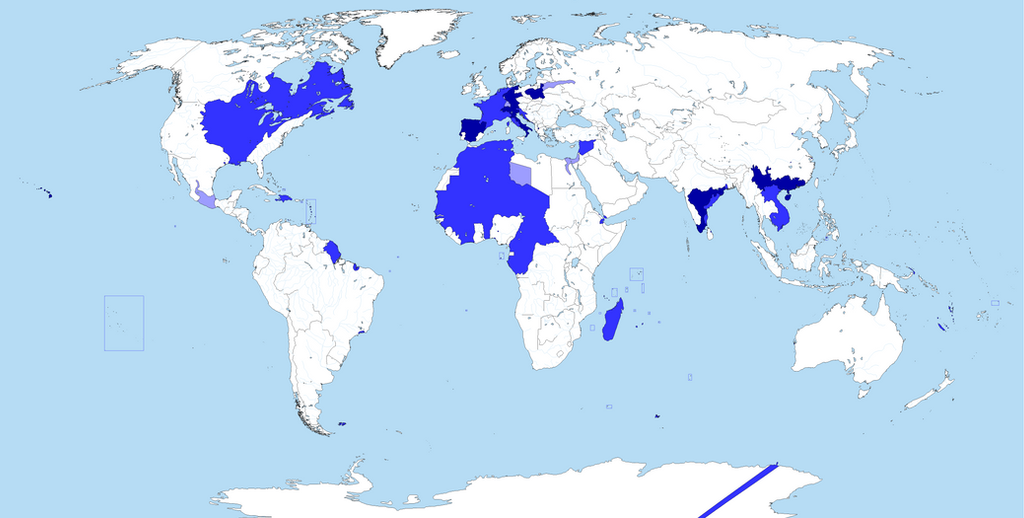
While that may be a seemingly innocuous statement, it obscures a few key things. Most glaringly, there’s an implication that France did not participate in chattel slavery, which it did, as did most Western European empires at the time. Secondly, while it is true that the French colonial empire extended to parts of Southeast Asia, any map of the modern French colonial empire will make it plainly clear that their rule extended primarily over Black nations — and that autonomy over Black states extended well into the the 20th century. The country where my family is from, Comoros, didn’t obtain independence until 1975; which is to say, my mother was born under French rule, with a French passport, and a French birth certificate.

What is arguably most glaring is this attempted bifurcation of race and religion — identities, which in France, are almost inextricably linked. Yes, France has a strong case of Islamophobia, which is made quite evident by things such as the “secular” law banning women from wearing religious headdresses in public, as well as the recently passed law enabling French government to revoke the birthright citizenship of anyone convicted of “terroristic” activity — terroristic activity being this amoebic catchall that is yet to be defined, of course.

That said, the key oversight in that assessment is that of the millions of French citizens and residents that self-identify as Muslim, approximately 80% of them at last count were 1st or 2nd generation descendants of the African continent. Subsequently, it is these people who are consistently harassed; pulled off trains and demanded to show their papers, pushed into slum communities (also known as banlieues), denied jobs they are qualified for, quality education or service without cause, arrested with limited justification, belittled via “satirical” comics.

And yes, even murdered, as we are in the United States.

On July 19th, Adama Traore, a Black Muslim Frenchman, died on his 24th birthday in police custody. As I write this, the family still doesn’t have any concrete answers as to what happened during his transport. This is a tragedy that we are all too familiar with here in the US, but it is a pain that reverberates globally; the extinguishing of Black bodies with little disregard or concern for the communities that continue to sear with the remnants of that anguish.

It is for those reasons that my cousin prays. She prays to not run into law enforcement. She prays for her daughter to not have to recall these memories before she should have to.

This isn’t the part of France you will see on TV. It might not even be the part of France you see in person; the banlieues exist on the outskirts for a reason, and if you just stay in the 20 arrondissements of Paris with your American passport in full view you may just consistently be viewed as a tourist first. I would certainly assume that a writer of Coates’s stature would be of the means to stay close to the city center, nor do I deride him for that choice. That experience, however, doesn’t dismiss the suffering of large swaths of Black communities just a few miles south. Black neighborhoods are being torn apart by fraught relationships with both police and non-POC demographics, and they are crying for their voices to be heard. We should take pains to not erase that context in framing our own personal experiences.

Baldwin once said of America, “all you are ever told in this country about being Black is that it is a terrible, terrible thing to be.” That sober reality unfortunately still hold us tight in our clutches in 2016; not just in the United States, but in large swaths of the Western World. Anti-Blackness is everywhere, even in the home of the Age of Enlightenment; and it would behoove us to step away from viewing White supremacy as a uniquely American problem as much as it is a pervasive viciousness that has left its imprints on Black populations the world over.

Donald Trump’s Pick for Secretary of Housing and Urban Development Could Harm People of Color

Originally published on  Teen Vogue January 23rd, 2017.


When I was in the fifth grade, my mother, infant brother, and I settled in the Colonial Houses Projects in Harlem (now named the Ralph Rangel Houses).

The first year was rough. After a year-and-a-half of transition — two weeks in a homeless shelter in the South Bronx, followed by a few months in a temporary living motel and a transitional housing facility — we had returned to Harlem with not much more than the clothes on our backs. I slept on an air mattress next to my infant brother for six weeks until we could scrounge enough money for a bed on layaway. The elevators and staircases consistently smelled like urine. The facilities were poorly maintained — poor trash pickup in front of the building contributed to rodents of all kinds, no matter how diligent my mother was about keeping our space tidy. The violence, while intermittent, was enough to have my mom worried about me coming home off the train after dark.

Despite all that, we had a home, and that meant the world to us. I got to invite friends over without having their parents sign them in with government ID. My mother had a full kitchen to cook in. I taught my little brother how to play basketball in Rucker Park just down the road, and I no longer had to wake up before the sun rose for a 90-minute commute to school.

Now, almost two decades after we originally moved in, much has changed about Harlem, but the frailties of public housing, run by the New York City Housing Authority (NYCHA), are still plagued by many of the same problems. These buildings remain overbooked and underfunded, with a waiting list in the thousands. Many buildings are still not properly up to code, with serious health and safety hazards — consistent heat and hot water issues, unsafe elevators, and lead paint just scratch the surface of infrastructure problems that predate my family’s arrival and continue to persist. And while I may no longer reside there, my mother still calls the beleaguered public housing system home, along with approximately 400,000 other New York City residents, of whom 90% are black and Hispanic.

If Dr. Ben Carson is confirmed by the Republican Senate majority as the Secretary of Housing and Urban Development (HUD), he will be responsible for coordinating and streamlining strategic efforts for affordable housing and community renewal nationwide, a domain which NYCHA falls directly under (as of 2016, it was estimated that around 85% of NYCHA’s Housing Preservation and Development budget fell under federal assistance from HUD). As a result, Carson and his team will be accountable for maintaining and rejuvenating a rapidly deteriorating ecosystem of half-century-old buildings that serve as a lynchpin for a significant number of New Yorkers of color, my mother included.

Not only are the buildings deteriorating and increasingly unsafe, but the funding is rapidly depleting. NYCHA is facing debt in the tens of millions, with federal funding for housing having been slashed by $24 billion nationwide in 2013 by Congress. Efforts by New York City Mayor Bill DeBlasio to increase development of affordable housing and tackle the hundreds of thousands of applicants on the waiting list has come at a cost; initiatives to acquire capital have included controversially selling off NYCHA-owned property to the highest bidder in an attempt to level off the rapidly increasing price points of New York’s neighborhoods with the largest populations of lower-income blacks and Hispanics. The erosion of this network would mean the displacement of entire communities, with nowhere to go and no places to afford in a city where the median rent is approximately $3,000 a month. The state of affordable low-income housing in New York is in disrepair and accelerating decline, and Ben Carson — a man with no city planning, urban development, or fiscal policy experience — will, if confirmed, be the one to lead us through it all.

It goes without saying that Carson faces an uphill climb; his seemingly severe lack of qualifications notwithstanding, any person slated to inherit the role would be faced with the quandary of managing a cash-strapped bureaucracy that directly affects millions of lives nationwide. In the face of our ever-present reality, the concern I have for my family and for thousands of others in the city I call home has increased; how can we make sure that a man whose only association to public housing to date has been his team inaccurately claiming that he grew up in a public facility sufficiently understand and address the needs of hundreds of thousands of lives of low-income people of color?

Carson has been noted as saying that “it is not the government’s job” to take care of our neediest populations — a jarring statement coming from someone poised to run a $47 billion agency dedicated to Fair Housing. Instead he has identified the solution to systemic poverty to be rooted in organic community initiatives instead of relying on government assistance, stating that “we the people have the responsibility to take care of the indigent in our society…the government started getting involved in everything…how did that work out? You know, $19 trillion later, 10 times more people on food stamps, more poverty, more welfare, broken homes, out-of-wedlock births, crime, incarceration. Everything is not only worse, it’s much worse,” according to CNN. He further contextualized his ideology with an anecdote: “In the old days of America when communities were separated by hundreds of miles, why were they able to thrive? Because if it was harvest time and the farmer was up in the tree picking apples and fell down and broke his leg, everybody pitched in and harvested his crops for him. If somebody got killed by a bear, everybody took care of their family.” This is all anchored by Carson’s belief that HUD and the federal government has “gone from providing housing to providing warehousing for an unacceptable number of people” and his dismissal of HUD initiatives as “social engineering.”

What seems to escape him, however, is that community building has never ceased. My mom couldn’t afford to give me an allowance, but my next door neighbor would let me tutor her son for some spending money. The family across the hall would let my brother stay there when my mom was working late cleaning houses. When I was in high school and coming home late from extracurriculars or hanging out with friends, it was the local elders who looked out for me and made sure I stayed out of trouble. There are daycares, senior centers, family days — all folding into the idea of communal support in the face of inauspicious conditions.

My family, as well as many others, had built a network of support within our housing complexes — but none of that can outweigh decay and mismanagement. A neighbor can help coordinate childcare, but how do you extend that helping hand to waiting weeks for repairs on a leaking ceiling? Placing the weight on the local residents to maintain their livelihoods and improve their quality of living not only diminishes the work that many of them have already done to create spaces for themselves, but falsely assumes that residents haven’t worked hard enough to combat the encroaching snare of capitalism and affordability in major cities. Simply put, Carson is stepping into the office with a bootstrap approach to affordable housing in low-income neighborhoods; it is this perspective that has me fearful for this gamble of a nomination.

In order for the NYCHA to serve and protect the lower income communities of New York City, significant investments need to be made in public housing’s infrastructure and development — facets that have long failed to be in line with Republican policy, and seemingly aren’t reflected in Carson’s, who has consistently expressed his distaste for government investment in public welfare and housing. This perspective is likely to come at a cost to the millions of beneficiaries of HUD aid across the nation, including the hundreds of thousands of black and Hispanic NYCHA residents across the five boroughs.

As we continue to discuss how “Black Lives Matter,” it is prudent to remember that this phrase does not merely apply in our unwarranted deaths. Conscious and active effort needs to be made to ensure the maintenance and enhancement of the communities that we call home, despite the behemoth of capitalism that threatens to eviscerate low-income communities. Within New York City, many of these lives are consistently striving for a better quality of life within the NYCHA system, including my mom. It is paramount that these livelihoods are defended and that we task Carson with holding true to the objectives of HUD. I, for one, plan to continue to hold accountable the man with my mother’s fate in his hands.

My mother is a Black immigrant. Today’s feminism doesn’t reflect her experience.

Originally posted in Washington Post’s “In Theory” section on December 1, 2016.


The first time I can remember hearing the word “feminist” in any capacity was in middle school, back when we had to complete presentations on suffragists during Women’s History Month. However, it wasn’t my book report on Susan B. Anthony (or whomever it was) that served as my introduction to feminism.

My relationship with feminism has never been merely a distillation of theory in exclusively academic or intellectual spaces. It has always been informed by my lived experiences as a black woman, as well as the experiences of the women who have surrounded me over my lifetime.

Those experiences have served to ground me time and time again with the fundamental truth that when it comes to feminism, the praxis can veer significantly from the theory — especially when the figureheads can be middle-class, educated white women whose day-to-day realities diverge from that of the low-income immigrant black women who molded me.

I was raised by a woman whose life course was initially dictated by men, but who ended up having to learn a new language and raise two children nearly alone. The struggles she experienced while obtaining her own autonomy in a foreign country served as the bedrock of her approach in raising me, her oldest daughter. For my mother, being able to put money in her own bank account and survive on her own merit gave her both the means and the confidence to be able to make choices for herself and her children, ultimately separating herself from a toxic and abusive marriage centered on a lack of financial independence.

Every life lesson she taught me was predicated upon making sure I had my own independence so that my choices weren’t limited by what a man was willing to offer me — that pursuing financial liberation from men was most fundamental. Feminism, for my mother, is about survival — trying to take it day by day in a system that is wholly disinterested in your success or failure. Her experience may not merit a paragraph in a textbook, but it is just as essential to my self-determination as anything that happened at the Seneca Falls Convention.

It is that perspective that continues to counterbalance any discussions in feminism that seem devoid of nuance or context. Beyond my mother, the realities of the black women I grew up with at the Colonial Houses in Harlem, or my aunts and cousins who are forging their own paths back in the Comoro Islands, are all voices that serve to frame my viewpoint right along with bell hooks and Audre Lorde and Kimberlé Crenshaw.

When Sheryl Sandberg’s “Lean In” took over book clubs of professional women across the nation, it was my mother who reminded me that many black women didn’t have the luxury of throwing caution to the wind and “seizing the day” in corporate environments without fear of significant obstruction or retaliation — working-class workers even less so. My mother was frankly more focused on initiatives to raise the minimum wage and what those would mean for the quality of life of lower-class communities as a whole.

Her grim outlook was colored by her decades-long work experience, trying to beat a game that was already designed to keep us out. By her mark, employing this “inside baseball” approach without lobbying to tumble the constructs that keep it in place was a method that rarely, if ever, trickled down to poor black women or addressed the majority of concerns that black women faced in the workplace. Intersectionality may not be the default word in my mom’s vocabulary, but she has long been aware of the impact of the multiple layers of oppression currently afforded to her.

Whenever I think about the mainstream’s relationships with feminism, I think back to that moment when “leaning in” took over the zeitgeist and the world lauded the genius of a women who could dedicate everything to corporate achievement. Dissent emanated not just from my mother, but from many women who didn’t check the boxes of “white, educated, married.” Feminism may indeed be truly for everybody, but as it currently stands, many narratives still tend to cater to a very specific voice. It does a disservice to the conversation to ignore this reality.

The good news? It doesn’t have to be that way. We are blessed to have access to critical thinkers from all walks of life who are able to provide incisive commentary on their own realities — women of color, different income levels and sexualities who have carved out spaces to lend their voice to detail how the multiple layers of their identities have shaped their feminism as praxis. My hope is that the coming years reflect an increased effort to amplify those voices so that their perspectives are no longer disregarded, submerged or co-opted but are instead given credit in their own regard.